Human Wildlife Preserve. Keep Out.
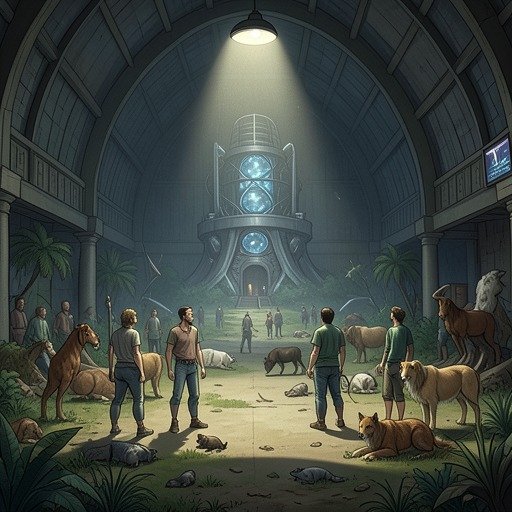
Gate Crashers“Human Wildlife Preserve. Keep Out.” is both a literal warning and the book’s most concentrated political metaphor. The message identifies Earth as a managed human preserve, transforming humanity from an apparently independent civilization into a population watched, bounded, and classified by powers beyond its knowledge. Its decisive significance lies in the ambiguity between protection and confinement: the boundary was designed to keep outsiders away while humanity developed, but the humans who discover it naturally read the fence as evidence that someone else has claimed authority over their world.
Discovery and First Meaning
The wording reaches Eugene through a tablet memo from the head linguist of the research group, marked “Signal 1 Translation.” The displayed sentence remains unchanged through repeated readings, an unnerving moment in which the translation’s simplicity gives it force. The linguists are more than 95 percent confident in the overall meaning despite disagreement over exact phrasing across seven languages. The warning therefore arrives not as a vague impression but as a highly reliable interpretation of an alien communication system.
Its blunt imperative intensifies the shock. The sentence offers no explanation of who owns the preserve, who is being kept out, or what authority established the boundary. It reduces a planetary civilization to the object of a sign, as though Earth were a site whose status could be announced without consulting its inhabitants. The phrase’s clipped structure also makes it portable: it can function as a label, a legal notice, a military exclusion order, or a zoo sign, and each possibility carries a different account of humanity’s place in the galaxy.
The Fence and the Human Response
The discovery immediately enters political debate. Gladstone Rockwell, whose public constituency masks his real alignment with Lockheed-Boeing-Raytheon, interprets the preserve through the language of strategic vulnerability. He describes humanity as being caged like zoo animals and asks how long it will take to reach the aliens and confront them. Eugene resists that conclusion, arguing that a network of buoys is more plausibly a territorial marker than a cage. Rockwell’s sarcastic response—that it is generous for outsiders to decide what humanity’s territory will be—exposes the underlying dispute: protection imposed without consent can look indistinguishable from domination.
The warning also helps drive Earth’s turn toward deterrence. Danielle Fenton explains that tensions were already high after the buoy and the mystery ship were discovered, but the “wildlife preserve” revelation becomes the last straw for the cabinet. The government consequently seeks to combine diplomacy with a demonstration of strength. The phrase thus produces the very militarization that its creators may have hoped to prevent. Once humans understand themselves as enclosed, the fence becomes a security crisis; once they prepare to resist, the preserve becomes evidence that humanity is dangerous.
What the Preserve Actually Was
Later testimony clarifies that the boundary was not intended to imprison humanity inside Earth space. D’armic explains that the fence was installed as a buffer zone while the species developed. Its purpose was to warn outsiders away from Earth, not to bind humans within it, which is why the message appears in the languages of the Assembly of Sentient Species rather than in a human language. The translation that initially feels like an insult is therefore also a protective notice addressed primarily to other civilizations.
The scale of the arrangement makes the revelation more profound. Jacqueline learns that a thirty-light-year-radius sphere requires 4,323,325 buoys, including the one held by the humans. The missing Buoy #4258743-E later exposes a hole in the fence, showing that the preserve is not an abstract metaphor but an engineered, maintained territory. D’armic has surveyed more than three thousand buoys over six farlems and has never found one out of position before; its disappearance is consequently treated as a breach in a system presumed reliable.
The preserve’s logic is also visible elsewhere in the galaxy. Culpus-Alam was set aside generations earlier as a controlled environment in which transported human tribes could develop distinct cultures while being observed. The next planned step was to facilitate contact among those tribes and study their interactions, with the aim of predicting humanity’s eventual integration into galactic society. The same institutional impulse therefore governs both the Earth fence and the distant experiment: humanity is protected, isolated, measured, and prepared for admission by authorities that regard observation as a legitimate form of care.
Surveillance, Power, and Reversal
The phrase gains a darker edge when the book reveals how observation operates in practice. On a planet inhabited by the Pirikura, an underground observation post activates when investigators enter it. Iridescent organic webs pulse along the walls like the interior of a buoy, while images of village roads, women, and children appear from multiple viewpoints. The villagers remain unaware of the watchers beneath them. This scene makes the preserve’s visual grammar unmistakable: the protected population is also a spectacle, and the distinction between safeguarding life and possessing knowledge of it is never secure.
The warning’s meaning is repeatedly revised as each side mistakes the other’s precaution. Vel Noric initially warns that, if humans return to Earth, they could use the marker to accelerate their technology and become a genuine threat within one or two human centuries. He is then told that a high-space portal has already been detected on Earth itself. What looks to humans like a fence that denies their freedom looks to the Assembly as a technological boundary whose violation may endanger the wider galaxy.
D’armic’s first contact with Allison Ridgeway makes the reversal explicit. He identifies himself as a frontier manager and announces his intention to take the human crew into custody pending judgment for the geocide of Culpus-Alam. The humans have understood the preserve as a warning against alien intrusion; the officials enforcing it understand human exploration as trespass into a managed site. The same boundary consequently produces opposing identities: humans see themselves as explorers defending sovereignty, while the Assembly sees them as intruders and potential destroyers.
Consequences and Significance
The preserve becomes a central instrument in the escalation from uncertainty to war. Human leaders treat it as proof that Earth requires teeth. Turemok forces later restrain the humans under suspicion of the geocides of Culpus-Alam and Okim, turning the broader preservation system into a legal and military framework for capture. In the Assembly hearing, Ruckk’s accusation gathers the humans’ actions into a history of piracy, territorial violation, serial geocide, destruction of an Assembly vessel, and the killing of peace officers. The preserve is no longer merely a sign at the edge of space; it is the institutional background against which humanity is judged.
Even when new evidence challenges that judgment, the machinery set in motion by the preserve cannot simply be stopped. Bloon states that the Assembly must investigate the evidence but cannot halt the punitive expedition already authorized against Earth after the destruction of Kulla was reported. The distinction between not wanting to stop an expedition and being unable to stop it reveals the final irony of the phrase: a system created to prevent contact has become so procedural and militarized that it can no longer prevent planetary catastrophe.
As an expression, “Human Wildlife Preserve. Keep Out.” therefore condenses the novel’s central conflict over who gets to define civilization, territory, danger, and protection. It is a boundary, a translation, a surveillance doctrine, and a provocation. Its apparent simplicity conceals an entire hierarchy in which one civilization names another as wildlife, confines it for its own supposed safety, studies its development, and reserves the right to intervene. The humans’ refusal to remain behind the fence is an assertion of agency, but the ensuing disasters show that agency exercised under conditions of ignorance can reproduce the violence of the system it rejects.